

The Power & Interest grid
Whether you've just landed in a new role or looking to move up, this one's for you.
I want to share how a simple framework helped two of my clients navigate complex stakeholder landscapes, and how you can use it too.
A promotion and a growing list of strangers
One of my clients was recently promoted into a leadership position after working together most of 2025. With the new role came a massive list of stakeholders, many of whom they'd never worked with before.
The challenge wasn't just meeting all these people. It was figuring out who to prioritise when every relationship felt equally important.
We discussed mapping out all of these stakeholders based on two dimensions: the level of power each person has and the level of interest they have in the product outcomes. They built a spreadsheet, plotted everyone on it, and suddenly it became clear who to meet with first and where to invest energy building trust.
A new role with too many opinions
A few weeks later, I shared this approach with another client who had just started a new Senior PM role at a new organisation.
Different situation, same core problem. She didn't know many people yet. Stakeholders were coming at her with opinions from every direction, and she wasn't sure which ones were worth incorporating into her work, and which ones, while frustrating, could be set aside.
The power-interest grid gave her clarity. She plotted her stakeholders on it and immediately knew where to focus.
She saw the impact right away. The next week, she could easily disregard frustrating feedback from someone who she visualised as being in the least important quadrant.
The power-interest grid
The concept is straightforward. You map every stakeholder on a 2x2 matrix:
X-axis: How much power does this person have over decisions that matter to you?
Y-axis: How much interest does this person have in you or your product?
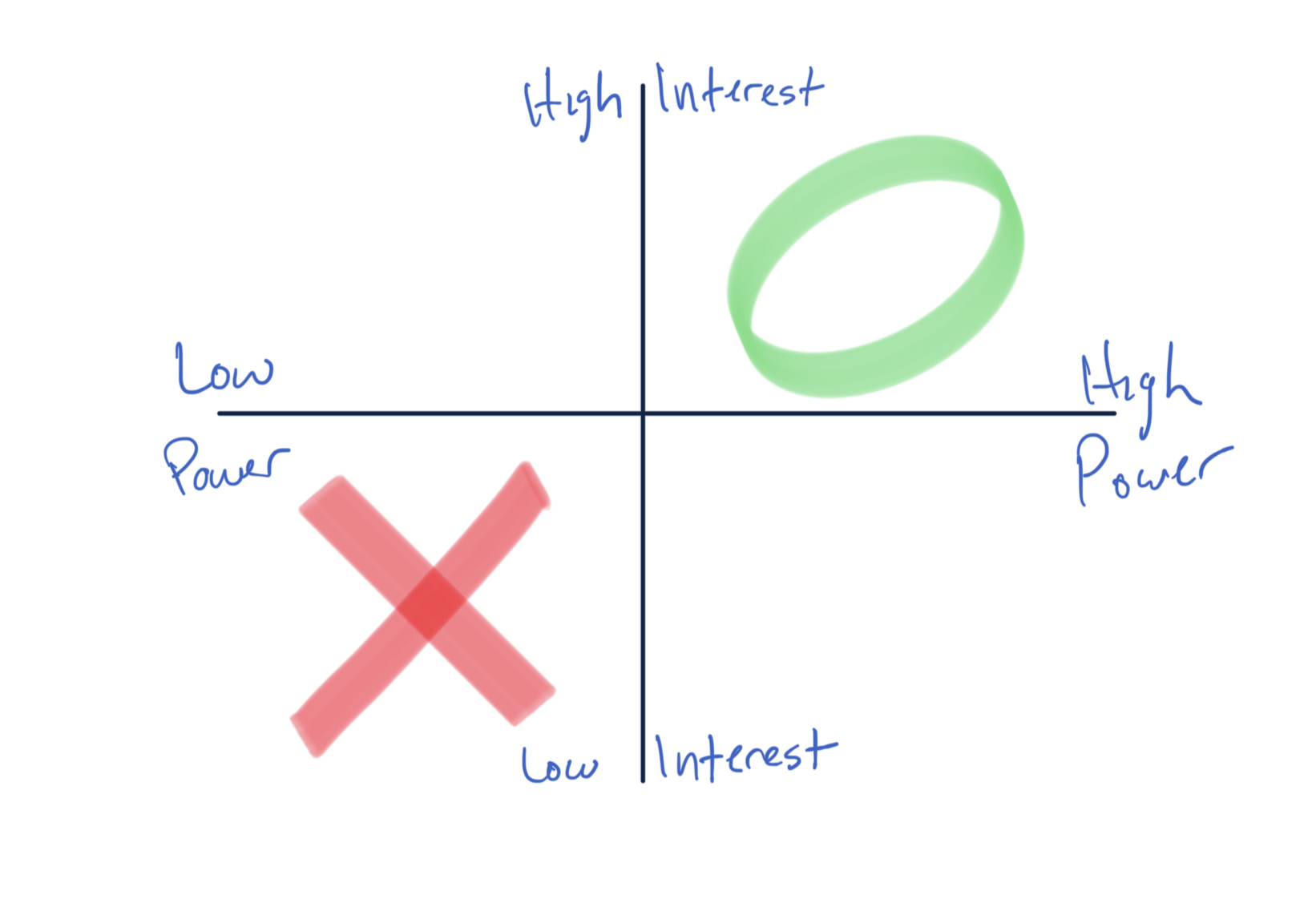
I’d rather draw than wait for an LLM to give me an image.
This gives you four quadrants. And you can build an approach for each, like so:
High power, high interest — Your key players. Invest your energy here. Regular check-ins, alignment on priorities, and proactive updates.
High power, low interest — Keep them informed. They may not care day to day, but when they do engage, their decisions carry weight. Don't surprise them.
Low power, high interest — These people care deeply about what you're building. They're often your best allies for feedback, testing, and championing your product internally.
Low power, low interest — Light touch. A brief update now and then is enough. Don't over-invest here. If they make noise, it’s probably not worth your time.
Why this matters
Without a map, you end up treating every stakeholder the same or don’t prioritise the ones that matter. That means either spreading yourself too thin or accidentally neglecting someone who can make a real difference in your growth.
The grid forces you to be honest about where each person sits. And that changes how you spend your time, and what opinions you decide to care about.
How to build your own
List every stakeholder you interact with or depend on. Include cross-functional partners, leadership, and anyone who influences decisions about your product.
Plot them on the grid. Power on one axis, interest on the other. Be honest about where people sit.
Design your engagement approach for each quadrant. Not everyone needs a weekly check-in. Some need a monthly update. Some just need to know you exist.
Revisit it monthly. People move. Priorities shift. New stakeholders emerge. Your map should be a living tool, not a one-time exercise.
You can do this in a spreadsheet, too.
The best product leaders I work with go beyond ‘managing their stakeholders’ organically. They manage with intention.
They know who cares, who decides, and who needs to be brought along.
And as a result, they get where they want to go faster.
Will you build your own?
Have you built something similar?
I'd love to hear about it.