

Stop proving yourself in executive interviews
A reader sent me a question last week that I wanted to address for you all.
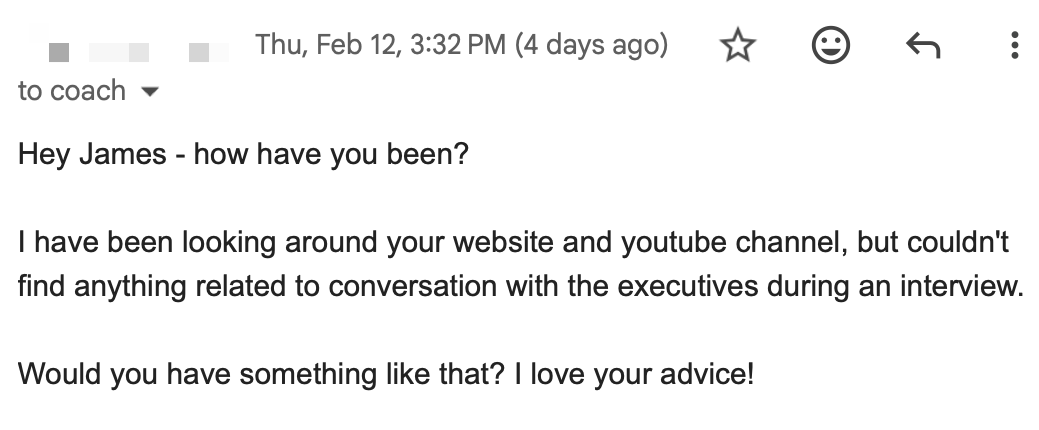
Her interview was in a couple of days, so I shot back a quick reply and wished her well.
I’m going to expand on it here for everybody else.
Before I jump into that, I want to quickly share my latest YouTube video where I cover how to build a better PM career.

It’s a deep dive to help you prioritise what to focus on to get more meaning, money, and impact in your career.
If it resonates, leave a like and subscribe for more.
On to today’s topic.
Interviewing with execs
If you've made it to an executive interview, something important has already happened.
The rest of the panel has decided you can do the job.
So why do most candidates still walk in trying to prove they're a good Product Manager?
By the time you're sitting across from an exec or C-suite leader, the hiring team has already validated your skills.
The technical rounds, the case studies, the cross-functional scenarios.
All of that was designed to answer the question: "Can this person do the job?"
And the answer was yes.
That's why you're there.
The executive isn't re-running the technical assessment.
They're asking a different questions:
"Does this person fit where we're going?"
“Can this person get us where we want to go?”
It's less about your frameworks and more about whether you'll thrive in the environment they're building.
What executives are looking for
When a senior leader sits down with you, they're typically evaluating three things:
Cultural and team fit — Do you match the environment they're building?
Strategic thinking — Can you see beyond the immediate role?
Leadership presence — Would they trust you in a room with their board or their biggest customer?
None of these are about whether you can write a PRD or run a sprint planning session. They (hopefully) trust their team to have made that determination before putting you in the room with them.
The questions they'll ask (and what they really mean)
Executive questions sound deceptively simple.
But each one is designed to reveal something specific about how you think.
"What kind of company or team environment do you do your best work in?"
They're checking alignment, not making small talk. They want to know if you'll thrive in their environment.
"Where do you see [technology/domain] heading in the next few years?"
They're gauging whether you think beyond the day-to-day. Can you zoom out? Do you have a point of view?
"What's something you'd push back on here based on what you've seen so far?"
This is a big one. They're testing whether you can be a thought partner. Someone who challenges ideas constructively, not just a hire who nods along.
"If you could go back to a previous role and team in your career, which would you choose and why?"
This is another tough one—and one that made me pause when asked by the CEO of Proton when I met with him years ago. They’re looking to understand how well you know where you thrive, and what your motivators are.
A story to learn from
Let me tell you about a client. We'll call him Daniel.
Daniel had been through four rounds of interviews. Technical case studies, cross-functional scenarios, you know the drill.
Then the final round landed: 30 minutes with the CEO.
The CEO asked him this question:
"What's broken about how most companies build product, and what would you do differently here?"
Daniel froze for a moment.
He was prepared to defend his experience, but now he needed to think out loud about the company's future.
He applied what I covered last week. Paused and gave a structured answer.
The CEO wasn't assessing whether Daniel could do product management.
They were assessing whether he could be a strategic partner in shaping where the product org needed to go.
After 7 silver medals on the job search, he finally got the offer.
He’s now leading the product function at the company.
So what should you do?
When you're preparing for an executive interview, shift your mindset:
Research the company's growth stage and strategic priorities. Know where they're headed, not just where they've been.
Prepare to talk about the future, and some of your past. Your STAR stories got you through the earlier rounds. Expect reflection questions more than “a time when you X.”
Have opinions. Executives want opinionated thinkers who can be thought partners. Not people who tell them what they want to hear.
Ask your own strategic questions. This is a two-way conversation. The exec wants to see how you engage with big, messy problems.
You won’t be the candidate that over-prepares for the wrong thing.
You’re going to walk in knowing the proof has already been established.
In that next exec interview:
Stop proving. Start connecting.
Show them you understand where the company is going. What you’ve learned in your career and from meeting with the rest of their team.
Then, they’ll know you are the right person to help them get there.