

3 AI stories. 2 traps. 1 new thing.
A few weeks ago I wrote about how AI won't give you time back at work.
That one stirred up some reactions. And I still believe it.
AI does raise the bar. It does create new expectations.
But I get it, there’s nuance and all that.
So I thought I’d share a couple of my own stories with you to learn from and reflect on.
I've been quietly using it to solve problems I never would have touched before. And the results have been kind of ridiculous.
Quick note: The full April PM Jobs Report is delayed by a week—I was on holiday. It'll land in your inbox next Sunday.
Fighting a collections agency with ChatGPT
Quick back story. Stick with me.
A rental car company— SIXT, if you're curious—sent a traffic violation I got in 2024 to collections.
All of a sudden, in 2026, some collections agency tells me to pay them £377.
Cool, right?
After digging in, I found the original citation was for £130, yet somehow collections wanted nearly 3x that.
The fine was for driving in a part of London without paying a congestion charge. It happened 2 years ago.
Back in June 2024, I made a fuss about SIXT not warning me about it as a newbie in the city, but they’re the kind of company to just screw over customers so it’s no surprise they didn’t bother.
We went back and forth a couple of times. Then, while waiting to hear back from them, the communication just stopped. And I kind of forgot about it, honestly.
SIXT sent no warning emails. No letters. No chance to settle it with them directly. Now, 2 years later, I’ve got a collections agency sending me a threatening email asking for 3x the money.
At first, I wasn’t even sure it was legit! I don’t know consumer law in the UK (don’t really know much of it in the US either, but my hunch is it’s weaker there).
Turns out it was legit.
So my options were simple: pay up and move on, or fight it.
I chose to fight it.
Not because the amount is life-changing, but because I felt wronged as a consumer and I refuse to reward that kind of behavior.
Here's where it gets interesting and where AI comes into the picture.
I first started drafting an angry email (the old way).
You know the ones.
You’re smacking on the keyboard and your partner or roomie asks you what’s going on.
They can tell…
And yeah that happened. I may have shouted some expletives about it too.
Then I stopped, and decided to get an assist from chat.
I think about AI helping with work problems all day. But not so much personal problems. I’m trying to change that.
So I dropped the email into a new chat and just asked it “what should I do?”
It guided me through all the steps. Cited the right UK law (with sources), and drafted an email for me.
I wish I could say it only took 1 turn with the collections agency, but it didn’t. And that’s where chat history saved me.
It’s been an ongoing back and forth now for weeks.
Each time a new email comes in, I go back to that chat, share the update, and have it write me the next message. I don’t have to remember what happened, the context is there in the chat.
This has already managed to save me from stress and anxiety. Plus I’ve already got the bill reduced a bit.
So I’m happy with how AI is helping me. But I’m not satisfied with that damn agency.
I’ve offered to settle and just pay the fine amount.
Wish me luck, yeah?
The point is this:
What used to be a major source of frustration, a small fight, is now just... a task.
One I’m happy to delegate to a chat bot.
Replacing SaaS tools I was paying for
I run a business (obviously). And LinkedIn, for all its faults, plays a big part in it.
So, measuring post performance actually matters for me. But I don’t believe it matters for job seekers (here’s what I recommend instead).
I pay for a tool called AuthoredUp. It’s a couple hundred bucks a year. Also not life changing money, but meaningful for a small business. That’s not far off from how much I pay for Notion which is crazy high value by comparison.
The main problems AuthoredUp solved for me were: helping with post formatting, publishing, scheduling, and measuring performance trends.
I’ve built tools in Notion to solve nearly every one of those problems except the “measuring post performance trends”.
When the subscription was up for renewal, I switched to monthly because I hadn’t fixed my ‘old way’ of getting performance data out of one tool and into another.
The old way: export data into Excel, build pivot charts, do a monthly data dump, update everything manually.
The new way: asked Claude to build me a browser extension that grabs my LinkedIn analytics and pipes the data straight into the Notion database I use to write, format, schedule, and analyze posts.
Then I had Notion AI build a dashboard from that data.
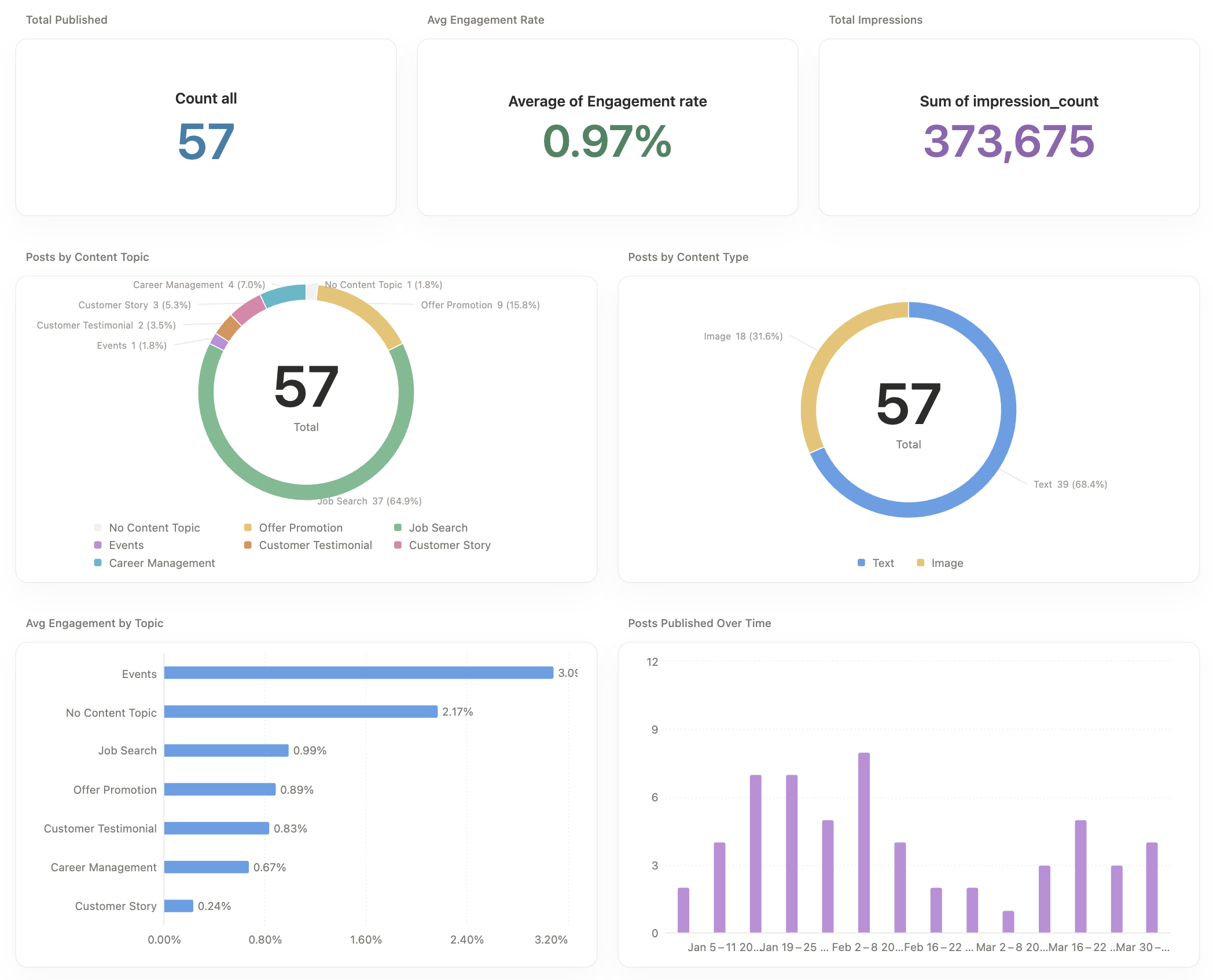
The one-shot came out really damn good, actually.
No spreadsheets. No monthly ritual. No SaaS subscription (except Notion).
Just data, where I need it, updated automatically.
All that with just a few prompts, some bug fixing, and some good jams to groove to.
The “you need a tool for that” used to just be the cost of running a business online.
Turns out, now you can just build the tool (in some cases—more on that later). Hat tip to one of my clients for the inspiration on that!
Writing Python without knowing Python
This might be where it gets a bit more dangerous.
I've never written a line of Python in my life.
Probably never will.
And yet I have Python scripts running that connect Notion to Kit (my email platform), Revolut, Stripe, Buffer, and other tools. Some on demand. Some on a schedule.
Before this?
Copy-paste CSVs.
Every. Single. Time.
Now? The scripts handle it. I built them by describing what I wanted to an AI and iterating until it worked how I needed it.
I still see the recurring question “should I learn to code?” from PM-curious career-switchers.
The answer from me is the same as it ever was:
You don't need to learn to code.
But you do need to learn to describe what you want clearly enough.
That's communication, a skill that matters a ton for PMs.
You write specs. You define requirements. You communicate trade-offs. You work with all kinds of different functions. AI is just a new function you can collaborate with.
So those are the three stories.
The traps to avoid
Ok, so this all sounds cool and you’ve no doubt seen 100 articles, posts, and videos talking about vibe coding and all that.
Consider this one more in the pile.
But here are the two traps I want you to consider (including one I deal with on the regular).
1. Just because you can doesn’t mean you should
Spending 5 hours on something with AI to save 3 hours is a net loss.
You can easily get stuck in a build trap when asking AI for help gets you 90% there in 10 minutes and the last 10% takes hours. Sunk cost fallacies are a thing.
Spending 10 hours to save 30 hours can also cost you if the problem you’re solving isn’t what moves a business forward.
That LinkedIn post metrics example above? Probably cost me nearly a day of effort to get going. Will it fundamentally transform my business in 2026?
Definitely not.
I struggle with this one a lot—the ability to build something, combined with the feeling of having done it, contrasted with the reality that it might have been a huge waste of time because now other tasks get delayed.
And what I’ve built may solve a problem I have, but is it a big enough problem worth solving?
There’s no easy fix for this conundrum.
It requires regular reflection, accountability, and recalibration.
2. Thinking you need to be doing all this stuff
Everybody moves at their own pace, deals with their own struggles, has their own priorities.
If you’re already someone who has an LLM app on your phone, occasionally uses it for things, you’re still ahead of the vast majority of the world.
If you’re dealing with anxiety because you can’t find the time, energy, or curiosity to go beyond the simple stuff, you probably need to shut off the feed, touch some grass, or just remind yourself that most work in the world is still getting done the ‘old way’.
And that’s totally okay.
I’ve said before that telling people to just “learn AI” is lazy. Saying “it’s table-stakes” might be true in some places, but it’s not true everywhere.
Keep your head up, just don’t get it stuck in the ground.