

This week I worked with two clients on their take-home tasks, back to back.
One was an 8-slide deck for a panel presentation with a VP & CPO.
The other was a written task, not dissimilar to one I did myself a few years ago (like, practically the same one).
In the end, both had done genuinely great work.
To get there, each had a different problem to solve.
Today I’ll cover why companies do these, and why they’re a problem. Then I’ll share how I helped my clients so you can ace your next one.
Why companies do take-home tasks
Companies assign take-home tasks for a few reasons.
They want to “see how you think.”
They want to engage in a bit of theater.
They want to weed out candidates who don’t really want the job.
For all their faults, sometimes these reasons can be effective.
The last interview process I was ever in? I ended it for that exact reason—I sat down to work on the task and all I could think was “this is f’ing boring and I don’t want to do this.”
The task was about the actual problems I’d have to solve in the role.
That’s how I knew exiting was the right decision.
But there are also drawbacks to assigning these tasks, too.
They introduce extreme bias (some candidates spend 4 hours, some spend 40).
They discriminate against candidates (unemployed people have more spare time than employed people).
And now they’re even more problematic as candidates experiment with using AI—on top of the companies pushing out AI generated tasks too, and not having clear criteria to evaluate against.
Yes, it’s obvious when Claude generated the deck or ChatGPT wrote the brief with excessive emoji headings, bolded intros on lists, and single line bullet points.
Anyway, take-home tasks, for all their faults, aren’t going anywhere.
What to do when presenting
One of my clients ran his full panel deck for me as a dry run.
Eighteen minutes, every section covered:
Segmentation, personas, problems, solutions, prioritization, and success metrics.
Technically complete.
But everything sounded equally important.
A panel can't tell what matters if every sentence carries the same energy.
The content, the product thinking—all solid.
It was the delivery that needed to change.
In my notes, the most important thing I wrote down was:
“Emphasize the why”
He listed out three segments and picked one. Explained why.
He listed out three problems and picked one. Explained why.
He listed out 2 solutions and picked on. Explained why.
But he delivered all of the information with a steady tone.
The VP and CPO he’d be interviewing with want to know why he made the decisions he did. That’s what needed to be emphasized in delivery.
Every story you tell in an interview, every answer you give, it lands when both content and delivery are strong.
So that’s what I told him to focus on.
He even wrote it down on a post-it before the interview so he wouldn’t forget.
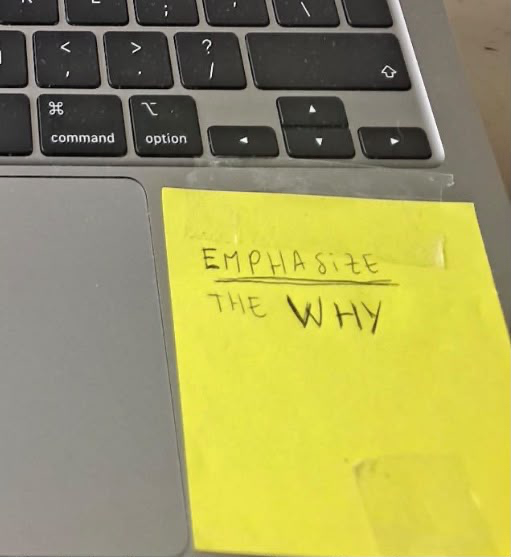
Shared with permission, of course!
It’s a communication technique to help differentiate you, and make sure your audience knows what the most important thing is.
Try it next time you’re telling a story and making a pitch.
Avoiding the AI trap
My other client this week had the opposite problem.
Her task was a written one. A strategy document reframing a product for a role she really wants.
The next interview is dependent on the task submission review.
She sent a draft of the doc for my feedback.
The thinking was there. The product instincts were sharp.
But the writing didn't sound like her. It sounded dangerously like an LLM.
You know the tells.
The over-polished phrasing.
The formatting quirks.
The technical terms that sound clever but add nothing.
The confident lines nobody could actually defend out loud.
The “not this, but that.”
If that sounds familiar, you've felt it too*.*
She had. It bothered her more than it bothered me.
So I gave her three things to fix:
Strip out the LLM language. If a human wouldn't say it, cut it.
Make the strategy and vision unmistakably clear. What are you proposing, and why?
Be able to stand behind every line. If you can't explain why it's there, it doesn't belong.
(hey, did you notice the 3 item list above with the bolded first line? classic LLM!)
AI can write a document in seconds but it won’t explain your reasoning for you in the room.
That room is where you’ll have to explain your rationale.
I’m not saying to not use AI on these tasks.
Use it to draft or structure. Use it to pressure-test.
Never let it do the thinking.
Never use it to replace the parts you’ll have to defend.
Always make sure the narrative is your voice.
She rewrote the whole thing and I took a second pass through.
Much stronger. No AI writing tells. And the strategy and vision were clearer.
Now she waits.
Take-home tasks can be a real struggle. Having a second set of eyes on it can make a huge difference. Whether that be from a coach, a peer, or a former hiring manager.
That’s what I do for clients, and members of my community.
By the way, the doors to my next Job Search Accelerator close tonight. They won’t re-open again until later this year. And my 1:1 slots are full.
If you need more help, join us.
Wishing you success
James